The sparkling wine came a month too early
It was Wednesday morning, 9:47, and the office was full. The web agency had just presented the finished site. The hero text had been lifted straight from the company brochure and shaped to fit the brand guidelines. The CEO nodded, the marketing manager smiled, and someone said it out loud: “This finally feels like us.” Sparkling wine was poured to mark the launch.
A month later, analytics showed a bounce rate of 87%.
Then the meetings began. Was the headline too long? Should the color change? What about a video? A working group was formed, and it wrote dozens of new versions, which were reviewed, discussed, voted on and softened into something everyone could live with. There was a new launch and a new measurement. Bounce rate: 84%.
Three points better. The communications team didn’t say anything.
Three weeks for three percent
I’ve seen this cycle many times, especially in Finnish companies, where decisions are made by consensus and the hero text slowly turns into an internal compromise.
I’ve also seen teams spend weeks A/B testing two headlines. Both were weak, but one performed 3% better, so it won, and everyone got to celebrate a data-driven decision. The honest answer would have been to throw both away and start again. That’s hard to say out loud to someone who has just spent three weeks on it.

In both cases the text had been polished plenty. It had been polished for the people in the meeting room, and the visitor who lands on the page for the first time has never been in that room. Another headline or a new font won’t change that, because what’s missing is structure.
What Netflix has in common with a Dutch consultancy
To see what that structure looks like, I took apart the hero texts of three companies: Corporate Rebels, Slack and Netflix. Consulting, software and entertainment, each sold to very different people. The same parts turned up in all three, in the same order. That’s hardly an accident. Attention works the same way whether someone is buying consulting or looking for something to watch tonight.
One warning before we start. A strong hero usually means giving up the way your company is used to talking about itself. None of these three open by describing themselves, and all of them start from where the customer is.
1. Nobody wakes up to “another day full of opportunity”

“But we don’t solve a problem. We sell entertainment.” Or: “We don’t have a problem, we offer an opportunity.” It’s one of my favorite arguments.
Fine. But your customer doesn’t wake up thinking great, another day full of opportunity. They wake up bored, or tired of searching for things, or wondering why everything is difficult again. If the page doesn’t meet them in that state, they leave. An opportunity can be inspiring, but it’s usually a problem that makes someone act right away.
Corporate Rebels, a Dutch consultancy that helps organizations move to self-managed ways of working, could have opened with “We modernize workplace culture.” Their hero starts with three words instead: Work is broken.
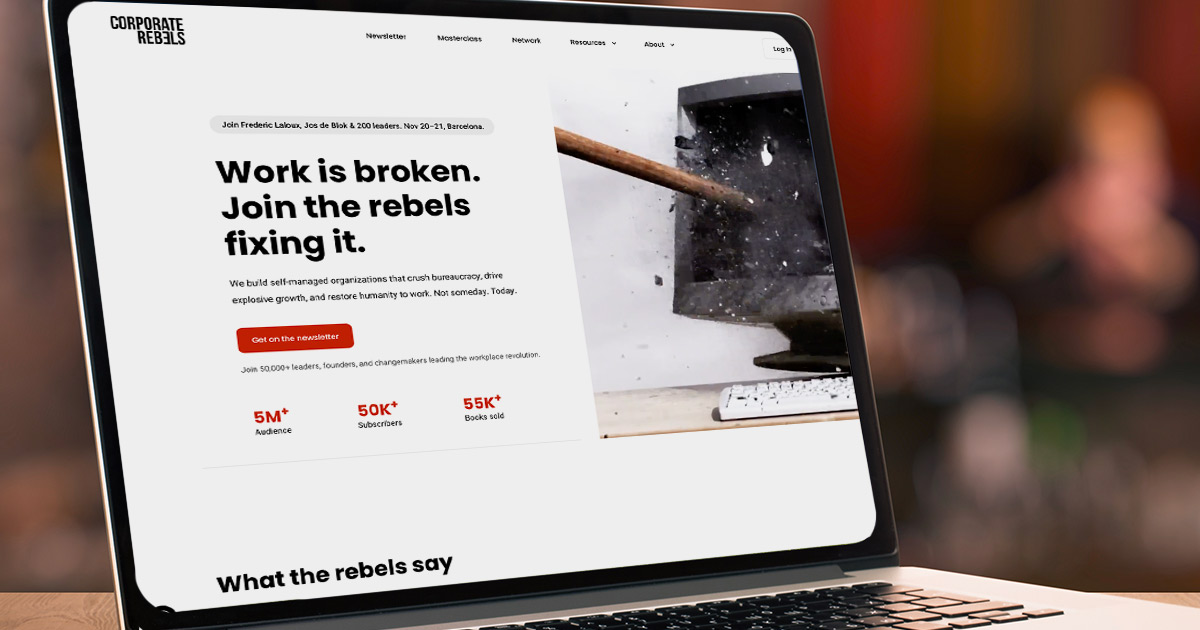
Everyone knows at once what’s being pointed at. Most companies try to fit everything into that first sentence: “We help companies improve efficiency, culture, agility and growth.” The reader’s first impression is formed by what Daniel Kahneman called System 1, the fast, automatic side of thinking, and System 1 doesn’t process lists. It picks up one clear signal, which is exactly what Corporate Rebels gave it.
Could the customer nod right away?
A good problem statement is something the reader can check against their own day. Read your hero text out loud and ask whether a customer would nod at it instantly. If the honest answer is “well, you’d have to think a bit about what it means,” you’re looking at internal language.
“We modernize internal communication” gets you OK… meaning what? “Your team’s messages disappear into email” gets you yes, exactly.
A problem the reader recognizes makes them willing to hear the rest. On its own, though, it isn’t enough. Someone can agree with you completely and still close the tab.
2. “Alright. Then what?”

Once the reader has nodded, they need to know where they fit in. Many hero texts stop at the problem, and a statement, however true, doesn’t hold anyone for long. The next line should tell the reader what they can do. What you do and who you are can wait.
Corporate Rebels follow “Work is broken” with Join the rebels fixing it. Without that line, the natural response to the first one is: alright, then what? With it, the reader is inside the story instead of watching it from the pavement.
A role is usually one short line the reader recognizes immediately: join, start here, take the next step, find the answer. It doesn’t always need a command, though. Slack’s long-running line is Slack is where work happens. There’s no imperative in it, but the role is built in. If you want work to happen in one place, this is the place.
Oddly, the less directly you command, the stronger the effect often is. “Join now” sounds like selling. “This is where work happens” sounds like a description of something the reader already suspected, and people like having their suspicions confirmed much more than they like being sold to.
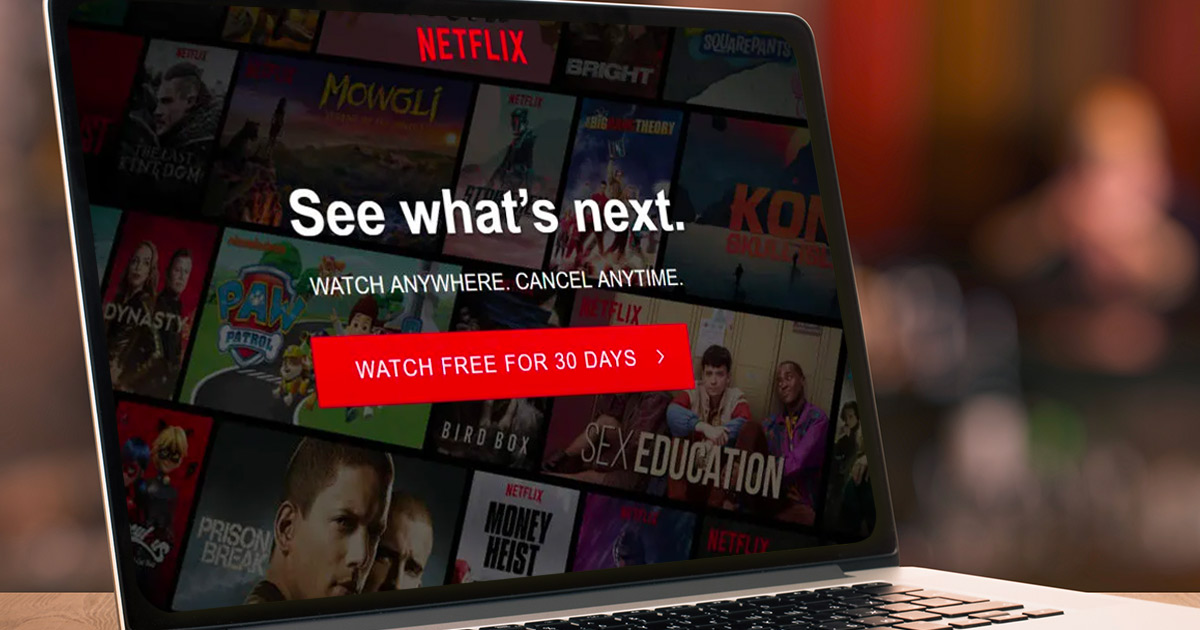
Netflix’s See what’s next points at the viewer’s own action rather than the service. You watch, and you decide what comes next.
Would it still work without your name on it?
Remove your company name and see whether the sentence still points at the reader. “We are a leading player in the industry” means nothing without a name attached. “Join the people fixing it” works fine on its own.
3. Delete “We are here for you.” What’s left?
The reader now knows this concerns them and that they can do something about it. The question that remains is what you actually do, and this is where many hero texts collapse into “we help you succeed,” “we support growth,” “we enable success” and “we are here for you.”
What does that last one mean in real life? That you exist? That you acknowledge the customer is a human being? It sounds warm and gives the reader nothing to use. If someone suggests it in a meeting, ask them to delete it and read what’s left, which is usually nothing.
What works instead is a concrete verb, an action the customer can picture happening:

- build
- fix
- speed up
- simplify
- remove
- automate
- make visible
- turn data into decisions
Corporate Rebels again: We build self-managed organizations that crush bureaucracy. Two verbs carry that sentence, and you can picture both: an organization being built and bureaucracy being flattened.
The words Slack never used
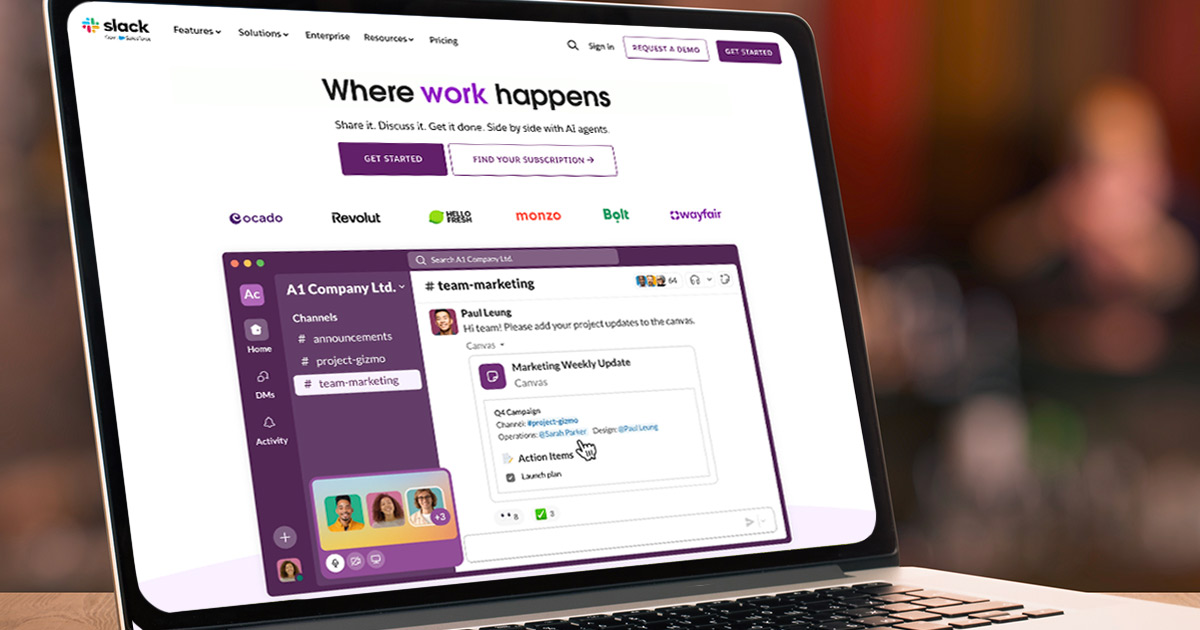
Slack never claimed to modernize communication. The action behind “Slack is where work happens” is obvious anyway: your work is scattered across email and a dozen tools, Slack gathers it into one place, and gathered work moves faster. It doesn’t “enhance” or “optimize” anything, it just speeds things up.
An imaginary company, Quantum E-Commerce Architects Oy, would probably write “We improve your ecommerce success through innovative solutions.” It could say “We speed up buying,” “We remove friction at checkout” or “We build stores designed for conversion.” Each of those describes a change you could watch happen.
Quantum E-Commerce Architects is made up. If such a company exists, this isn’t aimed at you. Not intentionally, anyway.
Abstract copy makes the reader interpret, and interpreting is work. “We enable growth” leaves them asking what that means. “We shorten the sales cycle by 40%” doesn’t. Your customer didn’t come to your site to do work.
A few shapes that tend to hold up: a verb and an object (“We speed up your team’s decisions”), a verb that removes friction (“We remove checkout bottlenecks”), or a verb with a decisive benefit (“We automate messages so you don’t have to”).
Could you see it happen?
Ask whether the action could be seen, heard or recognized in ordinary life. If it couldn’t, the verb is too abstract.
4. What was the milkshake hired to do?

Problem, role and action are in place. What’s still missing is why the customer would choose you now, at this particular moment. Your vision won’t do it, and neither will calling yourself a pioneer. The customer chooses you because they need a specific job done in their life. That’s the idea behind Jobs to Be Done.
Clayton Christensen’s best-known example is the milkshake. People weren’t buying it as a treat so much as hiring it to make a long, boring morning commute a little less boring. Once you know the job, you know why the customer opened your page, which moment of their day you fit into, and what the first line of the hero has to promise.
The job is never “learn more about your company” or “read your vision statement.” It belongs to the customer’s day, and it’s usually one of a handful:
- remove friction: don’t make me search, show me the way
- make something faster: I want this done now
- create certainty: I don’t want to get this wrong
- give a feeling: I’m bored, I want something now
- take responsibility off their hands: handle this for me
Who asked for an innovative partner?
Companies get lost when they ask what they want to be, when the useful question is what the customer wants them to do. You might want to sound like an innovative partner while the customer just wants someone to take the spreadsheet off their desk, and it’s the customer’s version that decides whether they stay on the page.
For Corporate Rebels, the job isn’t productivity consulting or workshop slides. It’s I need an alternative to bureaucracy. For Slack, it’s I need one place where work isn’t scattered and slow. For Netflix, it’s I want something to watch now, without effort, and “See what’s next” says exactly that.
To find your own, ask in what situation the customer hires you. When they’re stuck? Uncertain, rushed, irritated, bored? Then fill in the sentence:
The customer hires us to ________ so they can ________.
For example: the customer hires us to clarify a complex service so they stop losing customers to unclear messaging. Or: the customer hires us to keep boredom away so they get a moment of relief.
Would the hero survive without your service?
If you took your service out of the hero entirely and left only the job, would the customer still understand why they’re on the page? If yes, you’ve probably found the right job. If not, the hero is still telling your story. Once the job is clear, the right CTA usually becomes obvious too.
5. Can you read it in one breath?
All of this has to be said so that someone understands it in about a second. That means writing for System 1, which doesn’t analyze or weigh abstractions. It reacts to what is short, concrete and immediately recognizable.
Short sentences. “Work is broken.” “See what’s next.” If you can read the line in one breath, it’s usually fine.
Verbs instead of adjectives. Innovative, radical, leading. Adjectives make text sound polished and slow down understanding. Compare “an innovative solution” with “we automate invoicing.” An adjective describes how you feel about yourself, and nobody pays for that. Strip the adjectives from your hero and look again. If nothing is left, there may not have been a message in the first place.
One thing at a time. “We help companies improve efficiency, growth, culture and agility” sends four signals, and System 1 holds on to one of them at most.
Leave a small gap. Netflix doesn’t explain what’s next. It signals movement and leaves an opening the brain wants to close, which is part of why attention stays on the page.
Here’s a before: “We help organizations develop customer-oriented services and strengthen strategic competitiveness.” It’s long and abstract, and there’s no action anywhere in it. An after: “We clarify your service so customers understand it immediately.” One action, one benefit, and you can picture both.
Can you delete one more word?
Would you understand it at a glance? Can you picture the action? Could you remove a word without losing anything? If the answer to the last one is yes, it isn’t tight enough yet.
6. Three lines, about two seconds
This is usually where people ask how the parts become one hero. Many teams think of a hero as a headline, a subheading, maybe a supporting line and a button. It works better to think of it as a very short story. The brain doesn’t react much to information on its own. It reacts to change: something is wrong, someone deals with it, and the reader is invited in.
Here’s Corporate Rebels:
Work is broken. — problem
Join the rebels fixing it. — role
We build self-managed organizations that crush bureaucracy. — action
It takes about two seconds to read, and it’s a complete story. Without the second and third lines, “Work is broken” just sits there.
Slack compresses it further: “Slack is where work happens. Try for free.” Underneath is scattered, then gathered, then begin. Netflix does it with “See what’s next. Watch anywhere. Cancel anytime.” You don’t know what to watch, you can watch it wherever you are, and nothing ties you down.
Yours can be as plain as this:
Your customers hesitate.
Remove the friction.
We clarify the service so they understand it immediately.
Read it aloud. Does the first line describe the reader’s situation? Does the second put them in motion? Does the third say what actually changes? If one of them is missing, the hero goes flat, and you can usually hear it before you can explain it.
7. When does anything actually change?
A hero can have all of the above and still sound like something that might happen eventually. The last element is time: showing that the change starts now, not after a procurement round next spring. Sometimes it takes only a few words. After “Work is broken. Join the rebels fixing it,” a line like “Not someday. Today.” pulls the whole thing into the present.
8. Why would anyone click “Contact us”?

By now the reader has gone from this concerns me to this can be solved, and soon. If the story stops there, the momentum goes with it. The CTA is there to carry on the same story. When it works, the reader doesn’t feel they’re switching context at all.
CTAs often fail because they’re written separately from everything above them:
Work is broken. Join the rebels fixing it.
[ Contact us ]
The button starts a new subject. “Start here” would have finished the same sentence.
The button that must never change
Part of the problem is consistency. For designers and managers, a uniform CTA easily becomes a value of its own: the same button on every page, because changing it “breaks the system.” I see this constantly in projects. The CTA stays the same for visual reasons even when it breaks the logic of the hero above it. The intention is good. What sales needs, though, is coherence, content that supports a decision, and that’s a different thing from everything looking alike.
Build the CTA from the hero instead. It should offer the first step toward solving the problem, continue the role the reader was given, move toward the promised action, serve the same job and happen now. For Corporate Rebels, “Join us,” “Start here” or “See how we fix it” carry the story forward. “Read more,” “Learn about our services” and “Contact sales” end it.
Does it sound like one paragraph?
Read the hero and the CTA as one piece. If it sounds like one paragraph, good. If it sounds like a jump, the CTA is disconnected. Then remove the CTA: the hero should feel unfinished without it. Finally, compare the verbs. “Remove friction” followed by “Explore more options” pull in different directions.
9. What the other ninety-eight percent do

I once asked a client how many visitors clicked the CTA on their homepage. About two percent, they said. And what did the other ninety-eight percent do?
“They leave.”
A single CTA serves the people who are ready to decide right now, and that group is small, roughly 1–5% of visitors. The rest might still become customers. But if the only way forward feels too big, most of them take the third option and leave. Most of them never rejected the offer. There just wasn’t an easy next step.
The primary CTA is the direct path: buy, book, try for free, start here. It has to keep the hero’s rhythm. The secondary CTA asks for much less. It answers the question if I’m not ready yet, what can I do? with something like “See examples,” “Watch a 2-minute demo” or “Download the guide.” It should be a real alternative, visible but never louder than the primary one.
A simple rule: the primary CTA serves the main job, and the secondary one serves hesitation.
| Primary | Secondary | |
|---|---|---|
| B2B service | Book a 20-minute session | See case examples |
| Ecommerce | Buy now | Watch the product video |
| Consulting | Start the project | See how the process works |
| SaaS | Try for free | Watch a 2-minute demo |
| Entertainment | Start watching | Browse titles |
What would yours say?
If you want to try this on your own homepage, answer these in order:
- Problem. What in the customer’s day is broken, slow, unclear or frustrating?
- Role. Which words invite the reader to move?
- Action. What do you actually do? Use physical verbs.
- Job. The customer hires us to ______ so they can ______.
- System 1 line. One short sentence you can picture.
- Micro-story. Problem, role, action.
- Timeline. What makes the change feel like it starts now?
- CTA pair. One for the ready, one for the hesitant.
Filled in, it might look like this:
| Problem | Your customers hesitate because complexity gets in the way. |
| Role | Remove the friction. |
| Action | We clarify the service, simplify the structure and make the path visible. |
| Job | The customer hires us to make complexity understandable so their own customers don’t leave. |
| System 1 line | Your service, made instantly clear. |
| Timeline | Not someday. Today. |
| Primary CTA | Start clarity work |
| Secondary CTA | See an example |
Are there any Finnish ones?
A few. Not many at Corporate Rebels’ level, but some hold up well.
Valco: “The best headphones you can afford.” One everyday tension and a value equation you can see.
Varusteleka: “Buy it — you’ll need it anyway.” A direct action in spoken language, which only makes the signal stronger.
Wolt: “Food and groceries delivered.” One daily situation and one verb, with nothing added.
Each of them names one thing from the customer’s day with a concrete verb and leaves the adjectives out. When a Finnish company dares to do that, the result is often surprisingly strong.
The part that doesn’t look like writing
If you’ve read this far, you may have noticed that surprisingly little of it is about wording. A hero is rarely weak because of the words. It’s weak because the thinking behind it hasn’t been settled, and adjusting the words, a different headline here and a shorter sentence there, may move the bounce rate a little while the confusion stays where it was.
The work that helps is deciding what deserves emphasis, what comes first and what gets left out. It’s slower and less visible than writing, and often harder. Once it’s done, the words stop competing with each other. Visitors understand where they are, why it matters to them and what happens next, and they don’t need to be persuaded in the same way.
If your own hero still feels uncertain, it’s often because the page is trying to say several things at once. That’s where an outside view usually helps most. Mostly it means taking language away until the right signal is visible.