
There's a saying in marketing: "Nobody buys anything without reading the words first."
True.
But there's another one I find sharper: "Nobody cares about your solution. They only care about their problem."
That's not a branding insight. It's biology.
When users land in your product, their brain is running a cost-benefit analysis you never see. Every unclear label, every ambiguous button, every moment of "wait, what does this do?" triggers an energy calculation.
Is this worth figuring out?
Most founders think that question is about motivation or interest.
It's not. It's metabolic.
And here's what I've noticed after nearly three decades: most early-stage product teams believe their friction lives in layout.
They debate:
- Button placement
- Font sizes
- Background contrast
Things that are either already fine, or have such marginal impact that the work feels concrete while the technical lift stays small.
And yet users still hesitate.
Not because the interface looks broken.
Because they don't understand what it's asking them to do.
Here's why that matters more than most founders realize.
When a user encounters something unclear, their brain doesn't just "pause to think." It burns energy — converting glycogen to glucose to fuel interpretation.
This isn't a psychological metaphor. It's a physiological response.
Confusion triggers an energy-conservation reflex. The brain asks: "Is this worth the energy cost?"
If the answer isn't immediate, the automatic behavior kicks in.
They stop engaging. They leave. They don't come back.
I'm not saying this to dramatize the problem. I'm saying it because this goes deeper than usability trends or design virtue.
Clarity isn't about being nice to users.
It's about not triggering their brain's energy-conservation reflex.
What Most Founders Call a Design Issue Is Usually a Language Issue
Design attracts. Writing decides.
In the Cognitive Budget Model, every session begins with an entry state. Users don't arrive neutral. They arrive multitasking, uncertain, slightly overloaded.
Especially in B2B. Especially in early-stage tools where the promise exceeds the product's maturity.
Visual design influences first impressions. But writing determines interpretation.
A user doesn't experience your product as a grid system. They experience it as a series of micro-decisions:
- What does this do?
- Is this safe?
- What happens next?
- Am I about to break something?
Those decisions are resolved through language.
Buttons are language. Empty states are language. Everything is language.
Filters, toggles, confirmations, system feedback — all language.
Even the absence of explanation is language.
If your product feels confusing, slow, or "not intuitive," it's usually because the system is forcing users to translate.
Translation consumes budget.
The interface may look refined. But if it requires interpretation, it's expensive.
Signal Clarity Is Linguistic, Not Visual
Product teams often mistake visual minimalism for clarity. They remove decoration and assume comprehension will follow.
It doesn't.
We saw this play out dramatically between 2012 and 2013.
The flat design movement — led by Apple's iOS 7 — stripped away skeuomorphic elements. Gone were the puffy button gradients, the leather textures, the torn paper edges.
But along with those visual metaphors went something more critical: affordance cues.
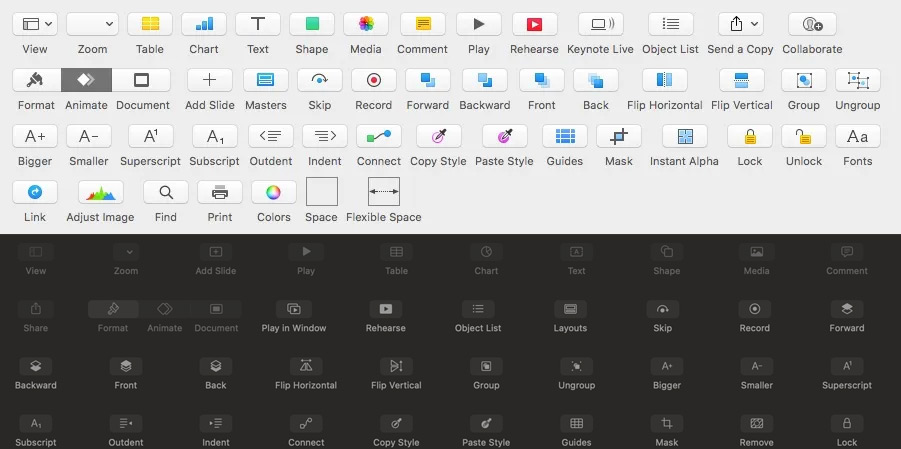
Colorful icons became monochrome. Layered depth became flatness. Tactile buttons became invisible tap targets.
The interface looked cleaner. But users had to guess what was interactive.
Visual noise dropped. Cognitive cost went up.
Because the problem wasn't the gradients. It was the language.
Take the generic "Read More" link.
What will I learn by reading more? The user already read the intro. They've parsed the context. But if the link said "See the implementation details" or "Read the case study," something shifts.
Instead of spending cognitive budget interpreting what comes next, the user loads themselves with anticipation.
Small difference in words. Massive difference in energy.
- When a button says "Generate," what is being generated?
- When a page says "Workspace," what lives there?
- When an error reads "Something went wrong," what should the user do?
Ambiguous writing doesn't feel dramatic. It feels subtle. Slightly vague. Slightly unspecific.
But subtle ambiguity compounds.
Each moment of interpretation is small. The cumulative cost across a session is large. That cost is paid in hesitation, abandonment, and mistrust.
Founders often say, "Users just don't get it yet."
More often, the product isn't saying what it actually does.
In AI Products, Writing Defines Capability
This becomes sharper in AI products.
When you build an interface around language models, the product surface is language. Capability is inferred through words. Trust is inferred through words. Boundaries are inferred through words.
There's no physical affordance to lean on.
A poorly written onboarding message in a traditional SaaS tool creates friction.
A poorly written onboarding message in an AI tool creates doubt.
- Can this system reason?
- Does it understand context?
- Is it hallucinating?
- What happens to my data?
These aren't design questions. They're linguistic ones.
The difference between a powerful AI product and a toy is often not the model.
It's the precision of how the system frames what it can and cannot do.
Language defines the mental model. And mental models determine adoption.
Most Teams Outsource Writing to the Wrong Layer
Design is owned. Engineering is owned. Roadmaps are owned.
Writing is nobody's responsibility.
It lives between product, marketing, and whoever happened to write the last release notes. It gets polished at the end. It gets "reviewed for tone."
It rarely gets architected.
Yet writing isn't decoration. It's infrastructure.
It defines system boundaries. It clarifies state transitions. It reduces ambiguity in irreversible actions. It shapes how users interpret feedback loops.
When writing is treated as surface polish, the product becomes cognitively noisy.
Not visually noisy — cognitively noisy.
Users can't tell what matters.
And when users can't tell what matters, they conserve energy. They disengage.
Noise Load Is Usually Semantic
In the Cognitive Budget Model, noise load is anything that competes for attention unnecessarily.
Teams assume noise is visual clutter. Too many icons. Too many colors.
In reality, noise is often semantic.
Multiple ways to describe the same concept. Shifting terminology between pages. Vague verbs. Overconfident promises. Underexplained constraints.
Stephen King wrote in On Writing that "The road to hell is paved with adverbs."
The same applies to interface language.
- "Quickly generate insights" is weaker than "Generate insights."
- "Easily manage your workspace" is vaguer than "Manage workspace settings."
- "Seamlessly integrate" tells you nothing about what actually connects.
I learned this the hard way at Nokia. We'd overpromised so many times with language like "easy," "simple," and "seamless" that customers started mocking us.
"Easy as 1-2-3" became "Easy as 1-23."
Because nothing was easy. We just kept saying it was.
Adverbs don't clarify. They hedge. They inflate. They make the action sound impressive while keeping it vague.
Users don't need impressive. They need clear.
This type of noise is harder to see because it doesn't look messy.
It feels slightly off.
A product can be visually calm yet semantically chaotic.
When terminology shifts, users hesitate. When labels are imprecise, users double-check. When system feedback lacks causality, users repeat actions.
Each repetition consumes budget.
Most early-stage startups aren't losing users because of pixel-level issues.
They're losing them because interpretation costs too much.
Writing Is Where Strategic Positioning Meets Product Experience
Founders often separate product clarity from positioning.
They treat messaging as an external narrative and interface copy as internal mechanics.
In reality, they're the same system.
If your homepage claims to "automate workflows," but your dashboard labels read "Tasks," "Spaces," and "Flows" without clear hierarchy, users must reconcile competing models.
If your AI product promises "strategic insight," but the system responds with generic output, trust erodes.
Clarity is alignment between promise and interface language.
This isn't a copywriting exercise. It's system design.
Cognitive Exhaustion Changes the Standard
Five years ago, users tolerated interpretation. They had margin.
Today, most users operate under constant cognitive load — Slack, Notion, dashboards, alerts, AI tools, email, analytics.
Your product isn't evaluated in isolation. It's evaluated as one more cognitive demand in an already saturated environment.
If your language is vague, users won't "learn it over time."
They'll switch.
Clarity is no longer a branding preference. It's a survival trait.
The Uncomfortable Conclusion
When founders say, "We need better UX," what they often mean is:
- Users don't understand what this does.
- Users don't trust what will happen next.
- Users hesitate at decision points.
That's not primarily a visual problem.
It's a writing problem.
And writing problems can't be solved by redesigning the layout. They require defining terms. Clarifying intent. Reducing semantic noise. Aligning capability with language.
In the AI era, language isn't just the interface.
It is the product.