

Product clarity
Ruokangas Guitars



Juha did not particularly want to come to my studio. I had told him I had changed the lighting in Guitar Creator and thought he should see it. He probably expected an hour of unfinished 3D and explanations about details that looked small to everyone except me.
He had another reason to be nearby, so he came. I opened Unity.
A Ruokangas guitar turned slowly on the screen. The flame birch moved in the light much as the real wood does. Juha stood behind me without saying anything.
A few weeks earlier, Jarno’s finished models had still been sitting on a hard drive. Java, the only developer who understood the whole system, had a company to run and very little time left for Guitar Creator. Now the browser version was nearly finished and the apps were being prepared for the App Store and Google Play.
Juha and I had been working on this since 2001. Not this exact version, obviously, but the same project in one form or another. Most Ruokangas guitars are now ordered through it.
For a digital product, twenty-five years is a long time to remain useful. During those years we had built Guitar Creator in Flash, rebuilt it in Flash and watched Flash disappear. The third version was made in Unity. By 2026 we had run out of developer and I was trying to finish it with AI.
The first version began after Juha threw me out of his workshop.
I went to buy a guitar. Juha threw me out.
In 2000, I left Razorfish to start a company with a friend. The dot-com bubble burst a year later and our company went with it. I did a few small freelance jobs for old clients. There was not much work and I had more free time than I wanted.
I decided that a new guitar might improve the situation.
A local paper had run a short article about a builder in the next town who made the best guitars in Finland, perhaps in the world. Soon I was standing in a workshop that smelled strongly of cedar, talking to Juha Ruokangas.
I told him his website was crap
Juha had built it himself in Microsoft FrontPage. He was proud of it and thought it compared well with the other guitar makers’ sites.
I told him I was a web designer. I also told him the site was ugly and the usability was, in fairly exact terms, crap.
Juha was unexpectedly offended by my expert assessment. The guitar discussion ended there and I left.
I rang the doorbell again
The guitar fever had not gone anywhere. I thought I might get back inside if I returned with something more useful than an insult.
Juha raised his eyebrows when he saw me, but opened the door. We talked for about four hours. The subjects were guitars, websites, craft, business and whatever else came up.
We have spoken to each other in much the same way ever since.


Email was taking over the workshop
Juha spent a large part of his working day answering customers. The specifications were on the website, but a list of woods, colours and hardware did not show what the finished guitar would look like.
Customers sent questions. Juha made mock-ups and replied. The more guitars he sold, the less time he had to build them.
I had worked on a Peugeot website and seen the first car configurators appear online. Juha had been thinking about something similar for his guitars.
Flash was the modern tool for that kind of work in 2001. I could not write a line of it. I agreed to learn.
I showed Juha my best design. He sent me to antique shops.
I worked on layouts day and night and showed Juha what I thought was the best one I had ever made. He did not like it.
He asked me to study heraldry and Art Nouveau, visit antique shops and compare the sound of a cheap car door with an expensive one. I knew by then that I was paying interest on the comments I had made during our first meeting.
The next design was better.
The weekend job took more than a year
It took more than a year. I designed the interface, drew the parts and wrote the front-end and logic while learning Flash.
We called it Guitar Builder and published it in 2002. Guitar forums began filling with screenshots of instruments people had designed. Customers tried combinations they might never have asked about by email.
Ruokangas grew enough to hire an apprentice for the workshop. Jyrki Kostamo is still there and is now one of Finland’s few master guitar builders. Guitar Builder later received a MindTrek award for innovation.
We knew Flash was in trouble. We kept it anyway.
By 2009 I was working at Valve, where I met Juha Javanainen. Everyone calls him Java. He was a very good programmer, a serious guitarist and someone I trusted enough to bring into the project.
I asked whether he would join what I described as an update to the Ruokangas website. Java was starting his own company and took the project through it.
There were already signs that Apple wanted Flash off its devices. I was doing my part in the evenings, and rebuilding Guitar Builder would have meant discarding years of work. Adobe was still enormous and Flash could do things HTML5 could not.
We built the website in WordPress and kept the configurator in Flash. I knew the risk and chose the existing work.
For a while, it worked
The update grew into a new concept and took another year. Java and I pushed each other hard, with Juha doing the same from the other side of the table.
The site received a Grand One honorary mention for information design.
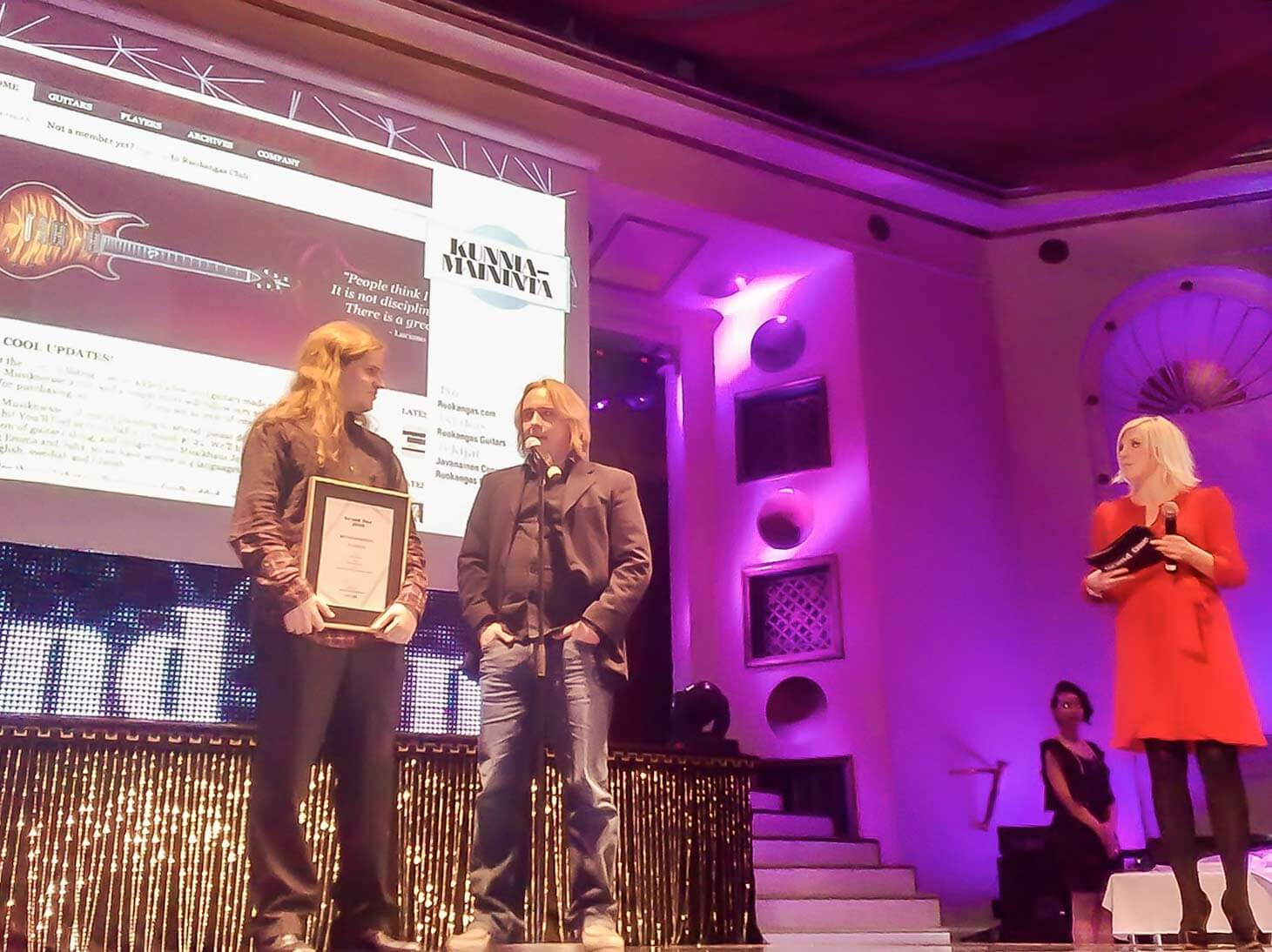
Guitar Builder was no longer an extra feature. Most Ruokangas guitars were ordered through it. New models shown in the builder and on YouTube could be seen in the sales figures, and the workshop hired more people.
Then Apple stopped supporting Flash.
Apple finally killed it
At first it was Apple’s mobile devices. Desktop browsers followed later.
Java and I spent too long hoping Adobe would find a way through it. There was too much working code to abandon without a fight. In the end there was no migration path and no workaround that made sense.
Guitar Builder still solved the same problem for Ruokangas and its customers. We could not keep the product without building it again.
Java joked about 3D. Juha wanted it.
The downturn reached Finnish digital agencies as well. I survived two rounds of negotiations at Valve and was let go in the third. I had built a reputation as a contrarian, so it was not a complete surprise. Fellowland lasted less than a year. Scoopshot lasted two.
By 2014 I was without a job again. Ruokangas was still there.
I asked Java if there was any platform-independent way to rebuild Guitar Builder. He mentioned, mostly as a joke, that 3D models could perhaps be moved from one platform to another.
This was an absurd amount of work for a company the size of Ruokangas. The technology was still developing and we had just watched the previous platform vanish.
Juha has a habit of taking grand ideas seriously. Once 3D had been mentioned, we were discussing how to make it.
Then Juha wanted the actual piece of wood on screen
In the summer of 2015 we met Jarno Vesa, an architect and guitarist who had agreed to model the instruments. He knew Ruokangas guitars in detail and had written a book about Finnish guitars.
Juha wanted customers to choose the exact piece of flame birch that would become the top of their instrument.
Flame birch grows in Finland with a twisted grain. Once the wood is planed, heat-treated and finished, the pattern has depth and moves with the light. No two pieces are alike. Some have small faults that affect the price without making the wood any less interesting.
A repeating texture would not do. We needed a growing library of photographed tops, each mapped to the 3D guitar so the customer could see the piece being offered before it was cut.
None of us knew yet how to make that work across a browser, phones and the other platforms on the list.
Java chose the platform
I had made the previous technical decision by staying close to a tool I already knew. This time Java investigated the options.
Unity was not our first choice. I wanted Guitar Creator to run in a browser and its browser performance was not good enough. Java kept testing as the platform developed.
Eventually the same project could cover iOS, Android and VR. The browser version was possible too, although at first only just. Jarno built the guitars and their options in 3D while Java designed the system that held them together.
By 2023 Guitar Creator was running in the browser without major problems. It looked better than the Flash versions and could finally show the individual flame birch tops.
The architecture had survived the long build. Maintaining it was becoming too much work for the only developer who understood all of it.
The only developer who understood it ran out of nights
By 2026 Java was running a successful IT company of his own. Guitar Creator work had to wait until his employees and clients had been looked after. That usually left the late evening, followed by a normal working day in the morning.
More often, he said there was no time. Jarno’s new models were finished, but they remained on his hard drive.
My own work had become quiet again. I had used AI for music videos, small pieces of code and assorted experiments. I wanted to know whether it could cope with this project, where a careless change could break years of somebody else’s work.
Juha did not think it would work. I was not sure either. We discussed it again a few weeks later and asked Java to stay involved as the person I could call when I did not understand his architecture.
We booked a day in Tammisaari to map the remaining work. Before that meeting I would set up the project and find out whether the idea was going anywhere.
I also promised Juha that if the experiment failed, I would deliver the agreed value in other work. This was my experiment, so I carried the risk.
AI was supposed to help with code. It started changing Unity.
I connected Claude to Blender and Unity through MCP and wrote a long file about the project: what must not change, how the assets were organised and everything else I could work out. Claude was the main tool. When its tokens ran out, I continued with Codex.
The first surprise was how much of Unity the AI could operate for me. It built automations for jobs I had assumed would be manual and completed missing parts of the backend.
When I reached something I did not understand, I had two choices. I could ask the AI to do it, or ask it to explain what Java had made. I began choosing the explanation.
That was how I learned the system. Java had already made the important architectural decisions. The AI made those decisions readable to someone who had not written the code.
It also made mistakes. Some changes broke things we had fixed earlier. A few of those were the AI’s fault. After looking more closely, a fair number turned out to be mine. I became better at noticing both.
I told Juha I had changed the lighting
The planned Tammisaari meeting was still weeks away when I asked Juha to visit my studio. I told him I had adjusted the lighting.
The original lighting had been designed around the limits of the hardware. With the AI helping me change and test the project, I had rebuilt it using the same principles I use in product photography. The light positions and colour temperatures were different, but the performance remained intact.
Juha came in, I opened Unity and the guitar began to turn on the screen. This was the moment at the beginning of this story.
He watched for a while. Then we started applying the lighting to the other guitars.
We cancelled Tammisaari
By the date of the workshop, there was no roadmap left to draw. The browser version was finished and the apps had been prepared for the App Store and Google Play.
The Android release found its own route into production. Juha logged in to correct some text and pressed publish without thinking. The test build went live.
I was horrified. We checked it and found nothing that prevented production use. It stayed there.
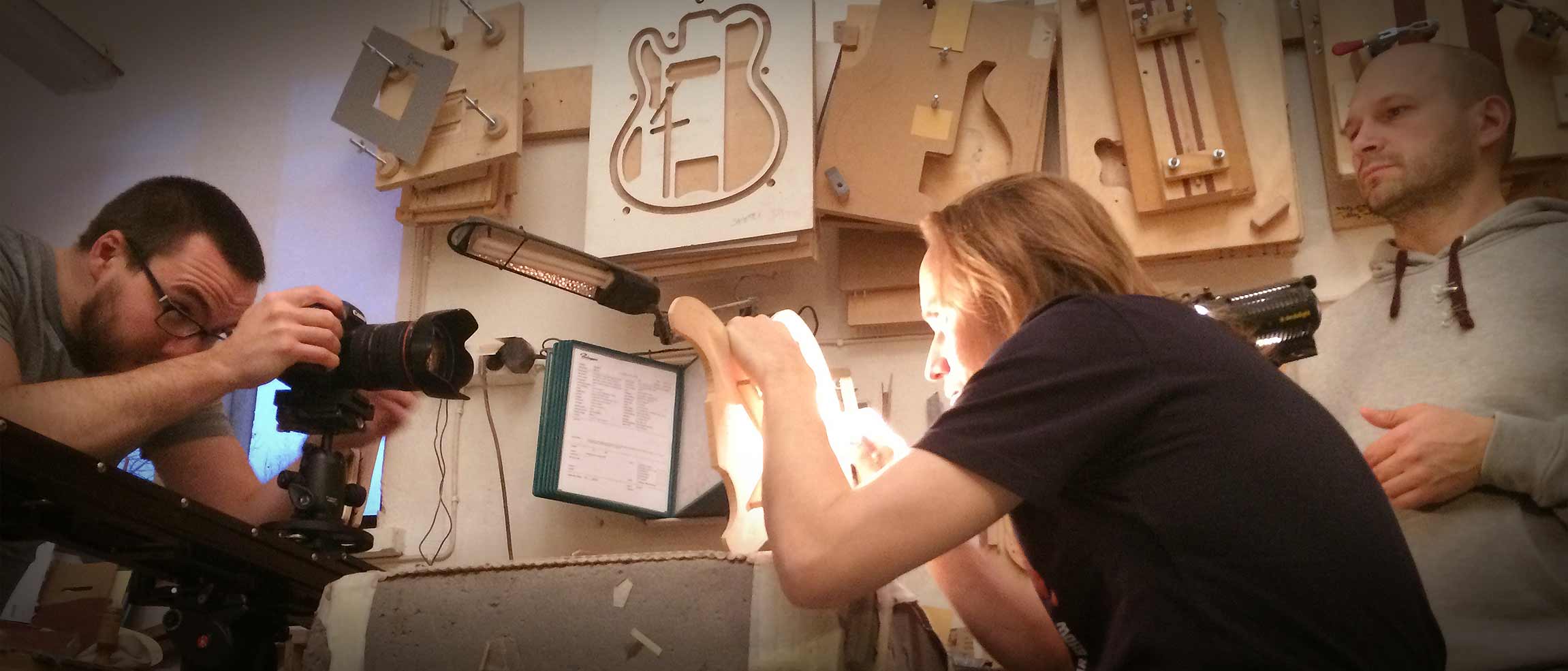
Then we made seven films and took thousands of photographs
A configurator could answer questions about woods, colours and hardware. It could not explain why somebody would wait for a handmade instrument or what the right guitar can do to a player.
While Guitar Creator was being rebuilt, so was the rest of the site. We rewrote the content, photographed the instruments and made films with players who had built part of their musical lives around them. The work took us to the United States and Germany as well as studios and stages in Finland.
The models received their own films and music. Thousands of photographs went into the site and the configurator. Matti, Markus, Mika, Nina, Emma, Antti and the rest of the team are credited below because this part could never have been made by two people sitting at computers.
The website and Guitar Creator received awards for UX, photography, copywriting and information design. They are listed below. Customers are still using Guitar Creator to order guitars.
Twenty-five years after I rang the doorbell
The question Juha was answering by email in 2001 has not changed much: what will my choices look like when they become one guitar?
The first Guitar Builder answered with drawings. When Flash disappeared, 3D gave us a chance to show the instrument and its wood more accurately. When the Unity project became too difficult to maintain in one developer’s spare time, AI helped me understand the system well enough to finish it and rebuild the lighting while I was there.
None of those versions came from a clean plan. Java’s architecture is still underneath the current one. Jarno’s models are there, along with Juha’s knowledge of every part and the work of the people who photographed, filmed, wrote, played and tested it.
Back in the studio, I was pleased that the AI had worked. Looking at the guitar on the screen, I could also see how much of it had been made long before the AI arrived.
I do not know how many digital-product client relationships last twenty-five years. I have not had another one. Ours did not continue because the work went smoothly. Quite a lot of it did not.
Juha could have stopped calling. I could have stopped ringing the doorbell. Neither happened.
Awards

FWA
Grand Prix
2019

FWA
Best Photography
2019

FWA
Best UX-Design
2019

GranD One
Honorary Mention - Information Design 2010

FWA
Best Copywriting
2019

Mindtrek
Win - Productive Innovations
2004
The Makers:
Design & Direction: Junnu Vuorela
Programming: Juha Javanainen / JCO Digital
AI-assisted development: Claude and Codex
Text Content: Juha Ruokangas / Ruokangas Guitars
Company Article: Mats Nermark / Fuzz
Videography: Matti Immonen & Markus Mutanen / Smak Film. Mika Tyyskä / Elektrik Pyjamas, Emma Elftorp / Ruokangas Guitars
Video Editing: Nina Ijäs, Matti Näränen, Emma Elftorp
Photography: Matti Immonen, Emma Elftorp, Kari Paukola
3D Modeling: Jarno Vesa
Animation: Mika Tyyskä
Music: Antti Paranko, Mika Tyyskä, Junnu Vuorela
Featured documentary artists: Juha Torvinen / Eppu Normaali, Aaron Kaplan, Jay Jay French / Twisted Sister, Antti Paranko, Mika Tyyskä / Mr. Fastfinger, Matias Kupiainen / Stratovarius, Markus Setzer